
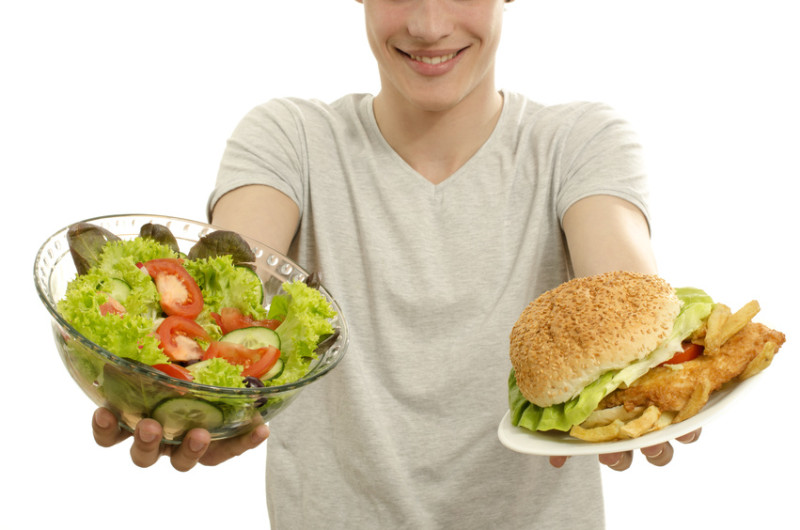
Tempted to munch on potato chips instead of carrot sticks? You’re not weak — your brain is just naturally driven to favor caloric foods. A new McGill University study, published in the journal Psychological Science, found that our brains tend to favor the more calorie-dense option when choosing between foods.
Here’s the interesting (and scary) part: Our brains seem to implicitly know which foods are packed with calories — no nutrition labels required. “It’s most likely through experience,” study author Alain Dagher, a neurologist at the Montreal Neurological Institute and Hospital, told Yahoo Health. Whenever you eat, our brains learn what nutrients are present in the foods we consume,” he said. “This is necessary, because humans are omnivores — we eat all kinds of things. So our bodies have to tell us what we need so that we shape our diets.”
When you’re making food choices — say, between chocolate cake and celery — an area of the brain called the ventromedial prefrontal cortex weighs in. “It’s the part of the brain that calculates value,” said Dagher. When the researchers performed brain scans on the people bidding on foods, this region lit up. “In our study, that area of the brain tracked caloric density,” he said. “This suggests that the caloric density of food is what determines the value.” Read: This part of the brain is not considering vitamin C or protein — it’s focused on getting the most caloric bang for your buck.
Problem is, in this era of overconsumption, we don’t need more calories constantly. But our brains are still driven to load up when the opportunity presents itself. “This was advantageous until maybe 30 years go. It’s only recently that we have very cheap food year-round.”
This natural tendency means that even if you’ve memorized the calorie counts of every food in the supermarket, you still may not always choose the healthier options. “People who go on a diet usually consult the labels. Yet they still have great difficulty losing weight,” Dagher told Yahoo Health. “So even though you might know what’s healthy and unhealthy, you might still be making wrong choices.”
(via Yahoo)
